I'm a Game Designer, deeply in love with creating worlds and their cultures. In games, I aim to immerse players in the narrative through their actions.
I have experience working in C#, Unity and blueprinting in Unreal Engine. As well as in modeling and texturing.
ViDu


ABOUT THE PROJECT
The ViDu project wanted to offer support in the grieving process through a psychoeducational video game, so that it can be played by grieving people and serve as a tool for psychology professionals in the treatment of pathological grief.
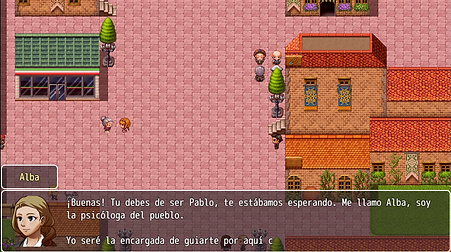
The demo shows the start of what the game would have been. A game in which the abilities are based on psychological techniques. They are taught one by one, to both the character and the player. At the same time, the game would have offered mechanics related to disconnecting from the grieving process. This happens by managing a greenhouse.
The game was developed for mobile and is completely in Spanish. So sadly I can't provide an English version.
WHAT I DID
The whole psychological base of the game (techniques, intervention process, ...) was designed by me in my graduation work (🔗). I received an honors degree for my graduation work and the project was awarded (🔗) on a regional and a national level (As the first price and as the most socially impactful).
Apart from the psychological design, I also did the mechanics design, level design, dialogues and programming of the game.
I also worked on the social media of the project (🔗). I created and managed an instagram and twitter account to educate people about the grieving process and publicize the game.
TEAM
Character creator update: Álvaro Jiménez Balmisa, Kadokawa and Rhino.
Narrative Design: Elena Cortés Alonso.
Design: Pablo Máta Gámez.
Programming: Pablo Máta Gámez, Pablo Martínez García.
Soundtrack: Gregorio Herreros, Tere Martos, Jesús María Boza Díaz.
Art: Juan Martínez, María Fornieles, Adolfo Rey Gimenez.
DESIGN KEY POINTS
A therapeutic approach
The design is based on studies that indicate that a player is able to replicate actions and attitudes from a game avatar (Van Looy et al., 2012🔗).With that in mind, the game allows the player to create themself, customizing their appearence and pronouns. They will embark on an adventure to discover a gift left by their departed one, from whom the player can customize the name and pronouns.
The complete game would have walked the player through all the phases of grief, based on the acclaimed (Llácer et al., 2019🔗) model of Alba Payás (2010🔗). In each phase, the player would receive missions related to the therapy methods used for that part of the grieving process.
Gaming to disconnect
In every process of grief, the patient needs to have both: moments in which they face the pain of the loss, and in which they can disconnect from the pain. That's why part of the tasks given to the player wont be related to the loss.
The most important one is taking care of the green house. This is a full build mechanic, in which you'll have to clean and renovate an old greenhouse. In the greenhouse you can grow many types of flowers and plants. With your harvest you can trade to obtain better equipment, seeds and improve the state of the greenhouse.
The growing of the plants is based in real time for two reasons. First allowing the game and the process of grief to take a natural course over time. And second providing a reason for the player to return to the game.
