I'm a Game Designer, deeply in love with creating worlds and their cultures. In games, I aim to immerse players in the narrative through their actions.
I have experience working in C#, Unity and blueprinting in Unreal Engine. As well as in modeling and texturing.
Trust Me Im A Doctor


ABOUT THE PROJECT
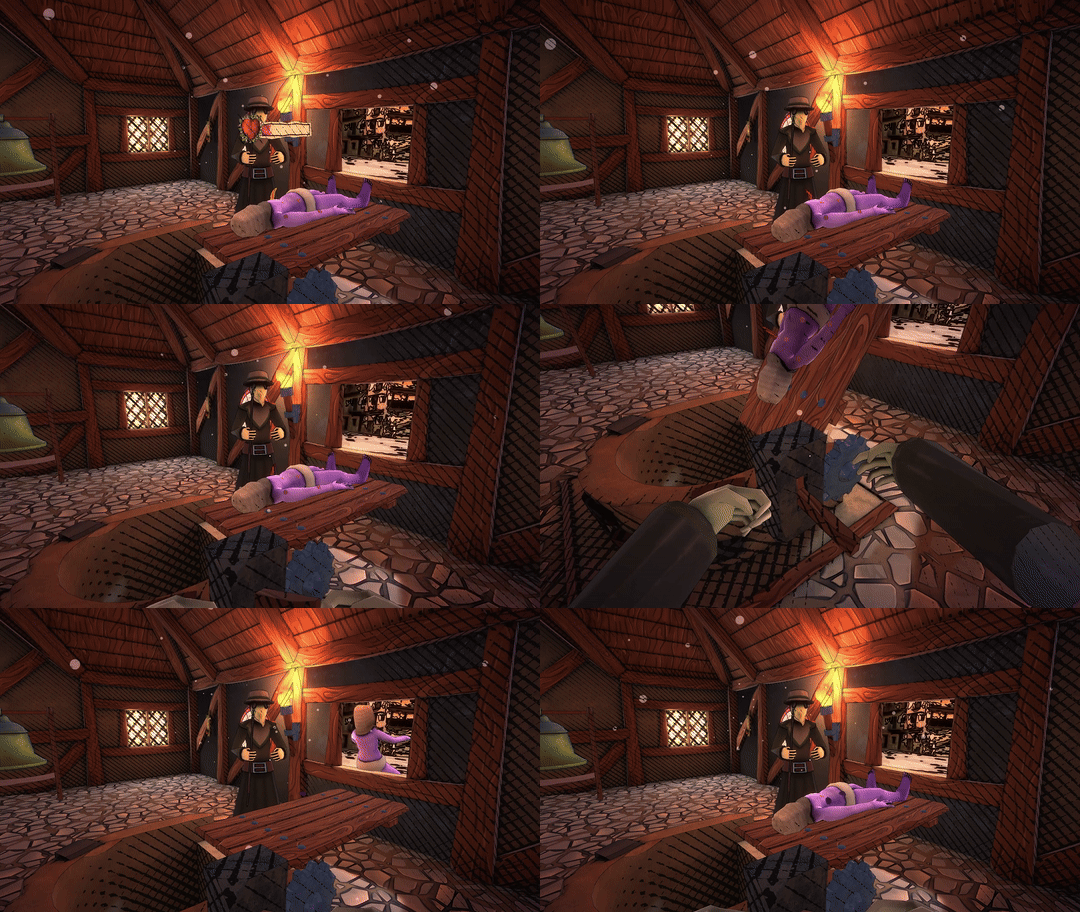
This is a two players game in which you play as plague doctors. Same as your character, you have no idea on how to deal with these old diseases. But fear not, all healing processes are described into an old manuscript. You'll have to read it to the other player while they describe the diseases.
This game needs two monitors to be played, as you shouldn't be looking at your colleague's screen.You´ll have to communicate with your fellow doctor and divide the tasks to be able to heal the patient on time.
WHAT I DID
In this project I did the design of the mechanics and the diseases, including the whole guidebook. I really enjoyed crafting a complex system of diseases and their cures.
I did most of the 2D medieval art, which I already had experience with from a previous project. I programmed the UI and sound system. I did the sound design as well .
I took care of the production and organisation of fthe team. I also did a devlog of the whole project🔗 on Itch.io.
TEAM
Programmers: Revekka Andronikidu.
Artists: Lorenzo Campi, Ruta Katkevica.
Designer and Producer: Pablo Mata Gámez.
DESIGN KEY POINTS
Communication
The main design pillar of the game was communication and how to make this a funny experience. I designed the game so that there is a constant need for communication between the two players.
The communication is based on describing strange diseases, unnatural healing methods and strangely similar plants. As well as conditions in the body (unnatural number of fingers or nipples); or conditions of the room (temperature).
The other part of the communication was the distributions of tasks. As part of the challenge is saving the patient on time.

Staying in scope
This was an ambitious project for the resources and time we had, but we really thought it was worth the effort. As a result, time and resource management became even more essential. This is how we dealt with this issue:
1- Cartoony animations. Solving two issues at once, we made the animations clunky and comical. Assessing the comedic theme of the game and saving us time.
2- Strangely similar plants. The plants were designed to be created with modular assets. Fulfilling two purposes: First saving us time, and second making the distinction between them difficult enough for the players.
3- Self reference. In the book, some diseases reference each others healing methods. Giving depth to the design and allowing us to introduce more variety without adding more work.
4-One ointment to rule them all. All ointments are the same object with a moving texture for the liquid. This texture would change color depending on the specific ointment.
5-I've seen that wall before. The environment was constructed using modular assets. Tables, floors, ceilings, windows and more. They all shared common assets.
6-Cut content for the DLC. I designed a second level that would have added more depth to the gameplay. Facilitating each player access to some areas and increasing difficulty to others. This force players to distribute the work in a different way. But that content fell out of scope, especially because we first needed a simpler room, so the player could easily learn the already complex gameplay.
The Manuscript
The manuscript is the core design piece of the game. Where all the guidelines for healing and creating ointments are defined. Crafting it was a complex task that I really enjoyed. The idea was to create a medieval medicine manuscript, difficult to remember the first time, but still giving the player the chance to improve.
Each group of diseases makes the player interprets the information in a different way. Adding complexity and variation. The diseases reference to each other, to atributes in the player or the room, and even a combination of the previous ones. Despite being fully conscious of the time limitation, I over engineered the manuscript, taking us time meant for the polishing phase. I think the game would have been more enjoyable with less variation and more polish. For this I held myself responsible and I I took this with me to do better in my future projects.
To facilitate the reading all the essential information was put in bold and red letters. Using the summarizing techniques of only highlight the actions and conditions, leaving all the connectors and fluff apart. In that way, only by reading the red words, the player can easily identify the healing procedures.
Testing was essential for this design process. Sadly the planned testing session during an event was cancelled. So we made our friends playtest as much as possible. Nevertheless, for me this was one of the key aspect that would have improved the game enormously. This experience taught me to have a playable game loop as soon as possible in production.

Comedy of the absurd
The essence of the game resides in the absurd. In the absurd of treating common diseases with extreme medieval methods based on the horoscope or the room temperature.
With that in mind, I planned with the artist to save time on the animations by making them clunky and comical. Also solving the problem of not having a specialized animator in the team.
In the same way, the manuscript is filled with jokes, absurd healing methods and funny drawings. The sound design of the game also fits this, being focused on cartoony sounds.