I'm a Game Designer, deeply in love with creating worlds and their cultures. In games, I aim to immerse players in the narrative through their actions.
I have experience working in C#, Unity and blueprinting in Unreal Engine. As well as in modeling and texturing.
Dixselya


ABOUT THE PROJECT
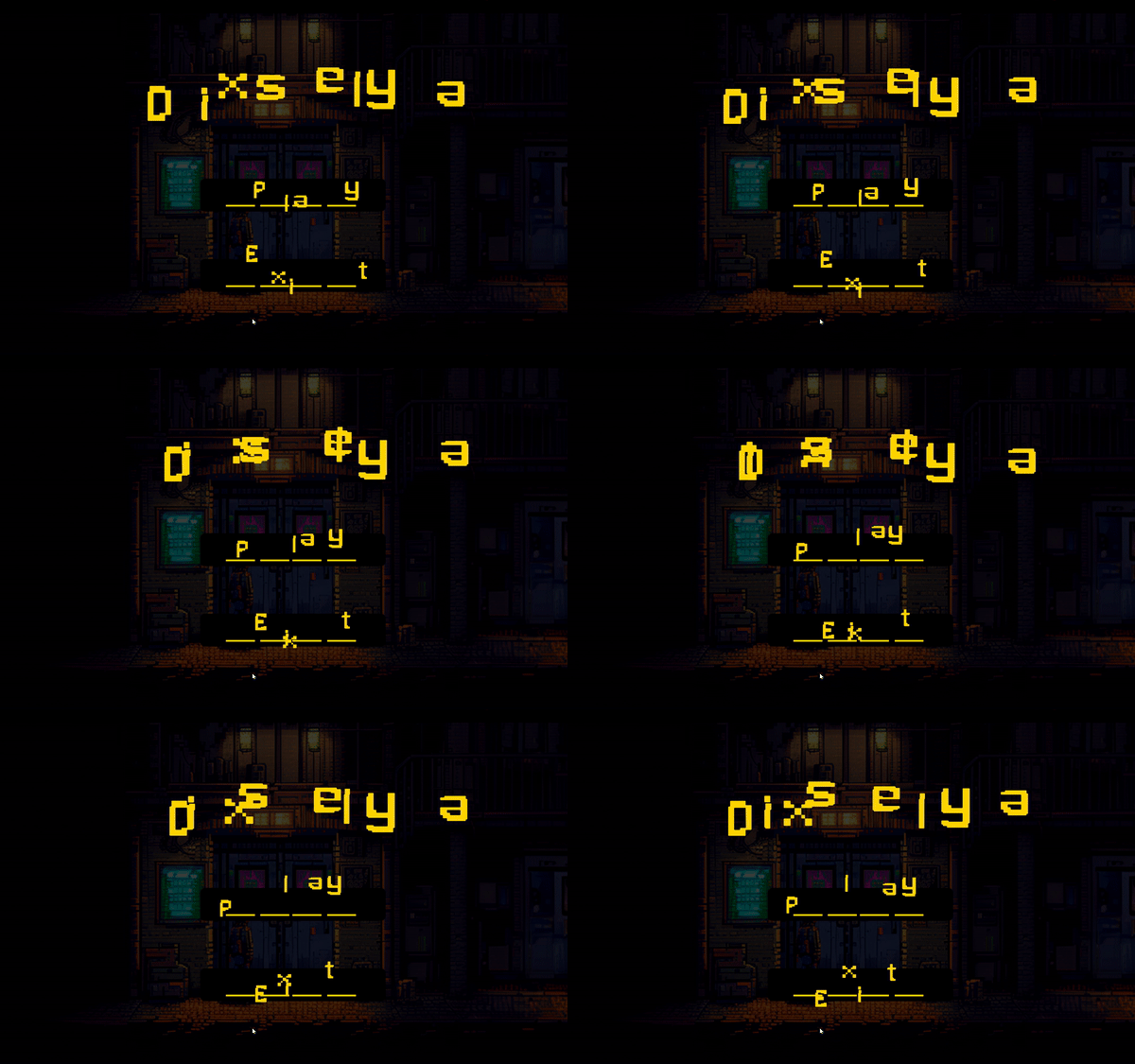
Dixselya is a single player role-play puzzle prototype. It is based on a unique speech mechanic. You’ll have to take words or letters from other people to create your own speech and resolve situations that will put you in thin ice.
The game was born from the idea of engaging players into reading, in a media in which players don't come to read.
WHAT I DID
I did basically everything for the project, design, programming and some UI elements. I used free assets for the backgrounds, character sprites and game music. You can find the in depth credits on Itch.io.
I also used generative AI pixel art for some backgrounds, as this was supposed to be a prototype. I'm well aware of how important is to credit all the art that AI has been fed and that generative art shouldn't be used as a final product. At the same time I consider AI a tool that should be used and learned, the same way that the industry mastered many other new tools that helped and improved the development of videogames.
TEAM
Solo project.
DESIGN KEY POINTS
Reading in videogames
As mentioned before, the main goal of this prototype was to find a game mechanic that attracted players to read the texts of the game. This idea came from the realization that most players skip or prefer not to read text while they are playing.
This situation has been attributed to the lack of attention span of new generations. Nevertheless the scientific literature doesn't seem to support this idea (Subramanian, K. R, 2018). The literature points out that it may be more fragmented due to the current culture. Which frequently promotes distractions, as people are bombarded with messages, notifications, and information from multiple sources at once. Resulting in frequently switching between tasks, conversations, or digital platforms.
As a conclusion, I took two different principles for the design of the game. Creating short texts; and presenting different tasks that the player can perform while the text is still there to be read. Adding the touch of using the text itself as a mechanic, to create a more immersive and interesting experience.
Prototyping
In this project is when I really learned how useful, cheap and fast "paper" prototypes are. Many of my previous efforts prototyping were spend programming, achieving only a fraction of what I wanted to show and try.
In this project I did a lot of paper prototypes, turning this into one of my favorite projects and designs. Here you can see an example of it.
Game loop and progression
I really enjoyed designing this game. The puzzles and interactions always felt very fresh and interesting. The progression of the game was the aspects I felt proudest of. 1. First was the basic mechanics as shown before. But then I wanted to add some exploration. Allowing the player to solve more complex puzzles and obtaining letters from street sounds:

2. After that I prototyped some ideas to broaden the immersion and narrative. Like allowing players to give two different answers with the same letters, having a time limit or a clue support system:


The next scene of the game was designed but never prototyped. Which would have created a fight scene. In which you have to quickly click on letters and syllables to create short words like "punch" "hit" "stop" "kick".
I will probably end up developing this game as a side project for fun.
Unity Interface
This project was done in my first year using Unity. Programming wise it's not a project I'm that proud of, but it allowed me to get a deep understanding of the Unity UI system. As the whole functionality of the game is based on it.